
Sounds like eddy current inside the magnets. It’s like magnetic breaking but the break disk is a magnet
breaks 300 year old law
Narrator: it didn’t
Is it really friction, though? It seems more like a case of one layer inducing mechanical work in the other, which in turn results in loss of efficiency due to inertia and actual friction within that layer.
In other word, I read this akin to an inductive coil moving through a magnetic field and drives a motor with a load. This will cause the coil to resist the movement, but it can hardly be called friction.
It seems more like a case of one layer inducing mechanical work in the other, which in turn results in loss of efficiency due to inertia and actual friction within that layer.
Now, define friction.
I know that sounds like just a pithy response without much thought put to it. But actually, that may be what friction is. I’ll also note that nothing about physics and the interactions of matter is actually as intuitive as it appears. For example one might say, “well friction is when two materials touch and rub against each other” but remember, materials never actually touch, the molecules of each material are only ever near each other at best. So what is happening that causes that resistive force?
The atoms repelling each other via the strong nuclear force… is that what causes resistive force? I don’t know, just asking,
Atoms repel by electrostatic forces. Essentially, electro-magnetism. The strong nuclear force acts on subatomic particles at distances far shorter.
Yeah, I think that pushes them apart, keeps them from actually occupying the same space. So that’s definitely involved. But why do molecules moving past each other lose momentum? I could make a guess, but I’m not actually certain. Like I said, physics tends to be pretty unintuitive at this scale.
(Technically I suppose they’re not losing momentum, they’re exchanging it for heat)
I have a private theory that it’s just fields all the way down. E.g., no electrons (as in separate things), just observable points in the one electromagnetic field. This helps me intuit the idea that energy transfers between things — with “transfer” simply being a kind of interaction between separate fields.
Electrons moving past each other slowing down? Can that be reproduced with an electron gun, or would this be based off a larger mass that includes other subatomic particles as well?
Fields aren’t observable. If I sprinkle some magnetic filings around a magnetic field, I will see the filings move, and even conform to the force lines of the field. But, at the end of the day, what I am seeing is the behavior of the particles, not the field. If all that exists are fields, then reality wouldn’t be observable, which clearly contradicts with what we observe.
Of course, you say that there “observable points” added to the field, but I don’t see how this is different form just saying that there are particles in the field, since that’s basically all a particle is, an observable point. Quite literally. Particles are understood as dimensionless points which are defined in terms of their observables.
If all that exists are fields, then reality wouldn’t be observable, which clearly contradicts with what we observe.
That’s fair, and I don’t claim that I am not redefining some things in my assessment. It’s more of a philosophical take.
When you “see light,” you’re detecting electromagnetic waves. That’s a physical phenomenon that may or may not count as direct observation, but it’s at least arguable.
Everything could, in theory, be reducible to fundamental parts which are no more “observable” than a field. Those fundamentals could be statistical anomalies, existing as a kind of probability function. The reality you and I have familiarized ourselves with may be the weakly emergent result of endless fields interacting, producing macro behavioral patterns that can be observed as isolated entities like “atoms.”
Of course, you say that there “observable points” added to the field, but I don’t see how this is different form just saying that there are particles in the field, since that’s basically all a particle is, an observable point. Quite literally. Particles are understood as dimensionless points which are defined in terms of their observables.
It’s really not different. I just find the alternative lenses more palatable.
I’m not sure the object’s particles are the observable parts though. When a photon bumps into your table and then into your eye, allowing you to see the table, does it bump directly into the table particles, or does it interact with the particles’ field?
Only one way to find out. Fire two election guns at each other and see what happens.
Set one to “stun” and one to “kill”. :)
That is string theory fyi
I actually got the idea from Quantum Field Theory. I only called it a “private theory” because I don’t know enough about the theory to actually claim I adhere to it… my understanding is most likely a dumbed down layman version.
What is your understanding of friction?
My uneducated understanding/intuition: Mechanical resistance to movement between two surfaces that touch. This resistance is partially caused by imperfections in the two surfaces that cause the surfaces to slightly mesh (which is why the force pushing the surfaces together is proportional to the friction). Also, partially, I am sure there’s some electromagnetic laws at play on the molecular level that resists the movement.
You brushed against the real truth there. Haha. Stupid joke, sorry.
The truth is that surfaces never “touch”. How do you touch an atom? Even an atom in a tight lattice or molecule is held in place only loosely by electromagnetic forces. The electron shells are a convenient idea more than they’re real, they’re not a real boundary for another atom to bump against. And the nucleus is so much tinier than the innermost shell it’s hard to wrap your mind around.
Basically, surfaces don’t truly exist. In reality the surface is just a fuzzy area where things are limited in how close they can get before the forces between the electromagnetic layers push back.
So friction is just when one electromagnetic fuzzy thing interferes with another electromagnetic fuzzy thing’s lateral motion, and that interference atom to atom creates movement in the lattice of each which creates heat.
This finding is just that in special circumstances those electromagnetic fuzzy things can be a lot further apart when they interfere with each other.This finding is just that in special circumstances those electromagnetic fuzzy things can be a lot further apart when they interfere with each other.
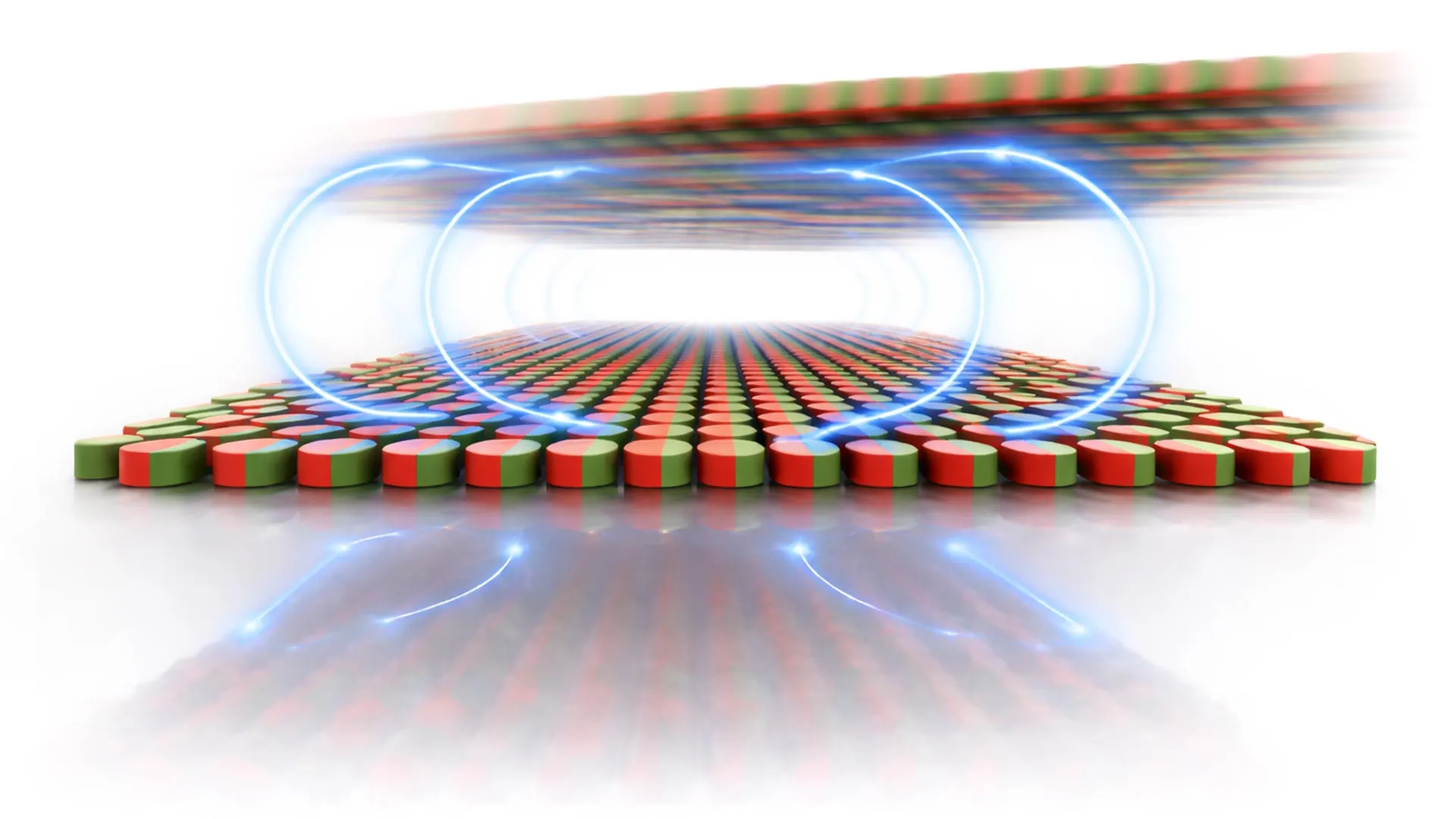
Reading the article it seems this research is about Amonton’s first law which is about the way friction increases with load. This experiment shows that in certain scenarios the friction can be low when the distance is close or far but at a medium distance (not sure the exact distances here) the friction increases thus breaking Amontons’ first law.
Given that they use an array of magnets that can rotate freely, it’s not “breaking” the law. At a distance the magnets are random and exert a force to lateral movement. Move the magnet array closer and the magnets align to the magnet below and the force changes.
It’s like saying a ball on a hill violates Amonton’s law. At the top of the hill you can push it easily. Push a little more such that it rolls down the hill and now in the valley of the hill you need more force to move it because pushing sideways means you are trying also push it uphill.
The magnets once flipped do not unflip when pulled back from the magnetic surface.
Given they are using an array of freely floating magnets it doesn’t seem like a big “breaking”. It’s possible to create normal mechanical systems that also “breaks” Amontons’ first law. For example, imagine a surface with an array of spring loaded pegs poking out of holes on a teflon surface. At light loads the object will have to slide against the pegs. But push a little harder and the pegs will push down into the holes of the surface and the object is now sliding on teflon.
Ah! Thank you for the correction. Much appreciated!
Oh wow a lot farther than i was thinking. I had guessed submillimeter. Thanks for the link to the paper.
Magnets such as those NdFeB magnets (N35 grade with nickel surface coating, HKCM Article No. 9963-73617 and HKCM Article No. 9962-61814) weren’t tested back then, I guess.
Sorry, I’m still not seeing the merit in this article/paper.
This finding is just that in special circumstances those electromagnetic fuzzy things can be a lot further apart when they interfere with each other.
I don’t see what’s new? Bulk magnetic forces vs atomic magnetic forces have been known to have different strengths for a very long time now.
I refer you to @teft@piefed.social 's excellent summation. My conclusion on the meaning of the research was faulty.
I think the LHC is the only certain source of friction we have.
False. Get someone red yelling at someone blue. All the friction you could ask for. ;-)