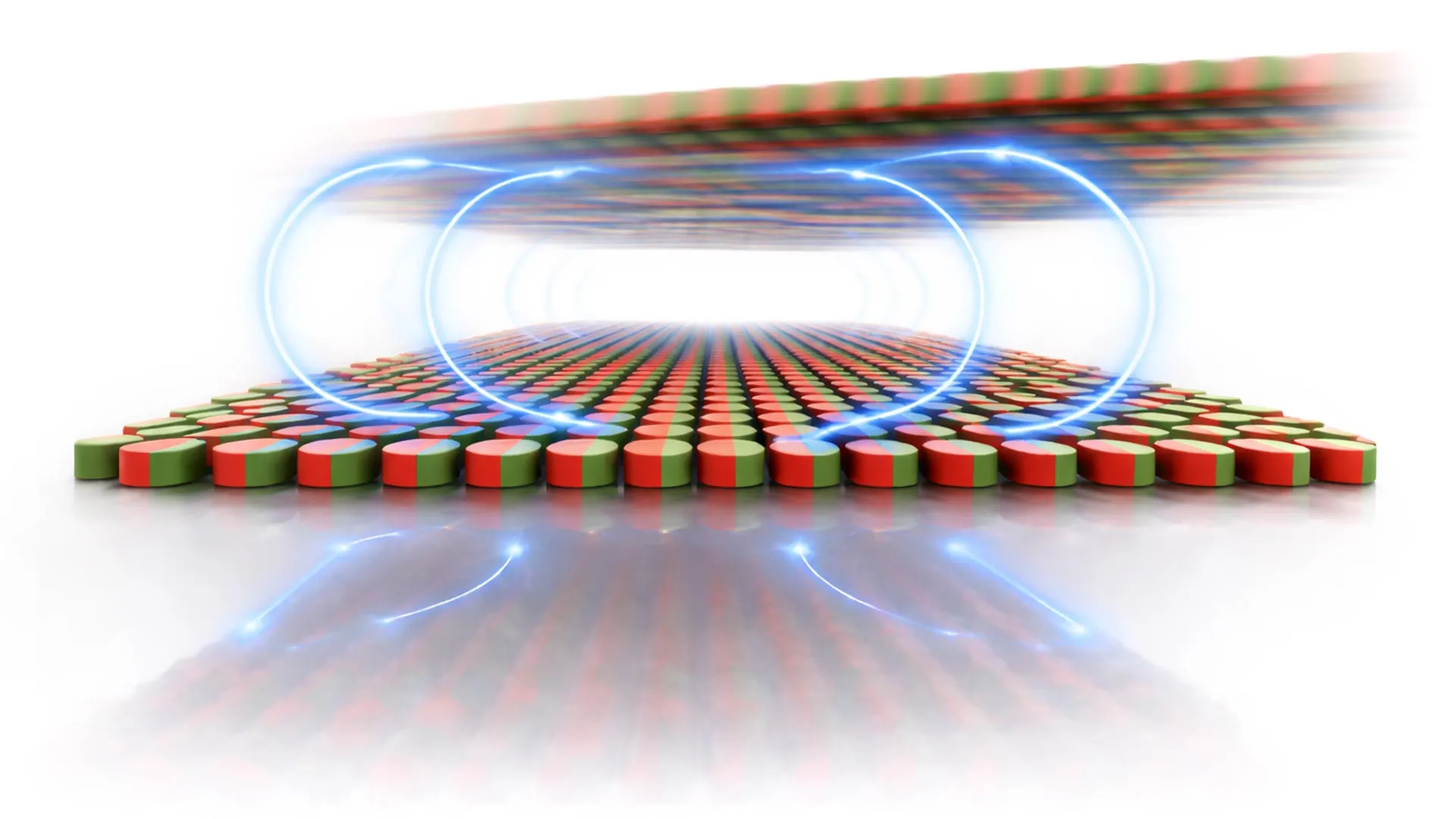
Researchers have uncovered friction without contact—driven entirely by magnetic interactions. As two magnetic layers slide, their internal forces compete, causing constant rearrangements that dramatically increase resistance at certain distances. This creates a surprising peak in friction instead of a steady rise, breaking a long-standing physics law.

What is your understanding of friction?
My uneducated understanding/intuition: Mechanical resistance to movement between two surfaces that touch. This resistance is partially caused by imperfections in the two surfaces that cause the surfaces to slightly mesh (which is why the force pushing the surfaces together is proportional to the friction). Also, partially, I am sure there’s some electromagnetic laws at play on the molecular level that resists the movement.
You brushed against the real truth there. Haha. Stupid joke, sorry.
The truth is that surfaces never “touch”. How do you touch an atom? Even an atom in a tight lattice or molecule is held in place only loosely by electromagnetic forces. The electron shells are a convenient idea more than they’re real, they’re not a real boundary for another atom to bump against. And the nucleus is so much tinier than the innermost shell it’s hard to wrap your mind around.
Basically, surfaces don’t truly exist. In reality the surface is just a fuzzy area where things are limited in how close they can get before the forces between the electromagnetic layers push back.
So friction is just when one electromagnetic fuzzy thing interferes with another electromagnetic fuzzy thing’s lateral motion, and that interference atom to atom creates movement in the lattice of each which creates heat.
This finding is just that in special circumstances those electromagnetic fuzzy things can be a lot further apart when they interfere with each other.Reading the article it seems this research is about Amonton’s first law which is about the way friction increases with load. This experiment shows that in certain scenarios the friction can be low when the distance is close or far but at a medium distance (not sure the exact distances here) the friction increases thus breaking Amontons’ first law.
Given that they use an array of magnets that can rotate freely, it’s not “breaking” the law. At a distance the magnets are random and exert a force to lateral movement. Move the magnet array closer and the magnets align to the magnet below and the force changes.
It’s like saying a ball on a hill violates Amonton’s law. At the top of the hill you can push it easily. Push a little more such that it rolls down the hill and now in the valley of the hill you need more force to move it because pushing sideways means you are trying also push it uphill.
The magnets once flipped do not unflip when pulled back from the magnetic surface.
Given they are using an array of freely floating magnets it doesn’t seem like a big “breaking”. It’s possible to create normal mechanical systems that also “breaks” Amontons’ first law. For example, imagine a surface with an array of spring loaded pegs poking out of holes on a teflon surface. At light loads the object will have to slide against the pegs. But push a little harder and the pegs will push down into the holes of the surface and the object is now sliding on teflon.
Ah! Thank you for the correction. Much appreciated!
Oh wow a lot farther than i was thinking. I had guessed submillimeter. Thanks for the link to the paper.
Magnets such as those NdFeB magnets (N35 grade with nickel surface coating, HKCM Article No. 9963-73617 and HKCM Article No. 9962-61814) weren’t tested back then, I guess.
Sorry, I’m still not seeing the merit in this article/paper.
I don’t see what’s new? Bulk magnetic forces vs atomic magnetic forces have been known to have different strengths for a very long time now.
I refer you to @teft@piefed.social 's excellent summation. My conclusion on the meaning of the research was faulty.