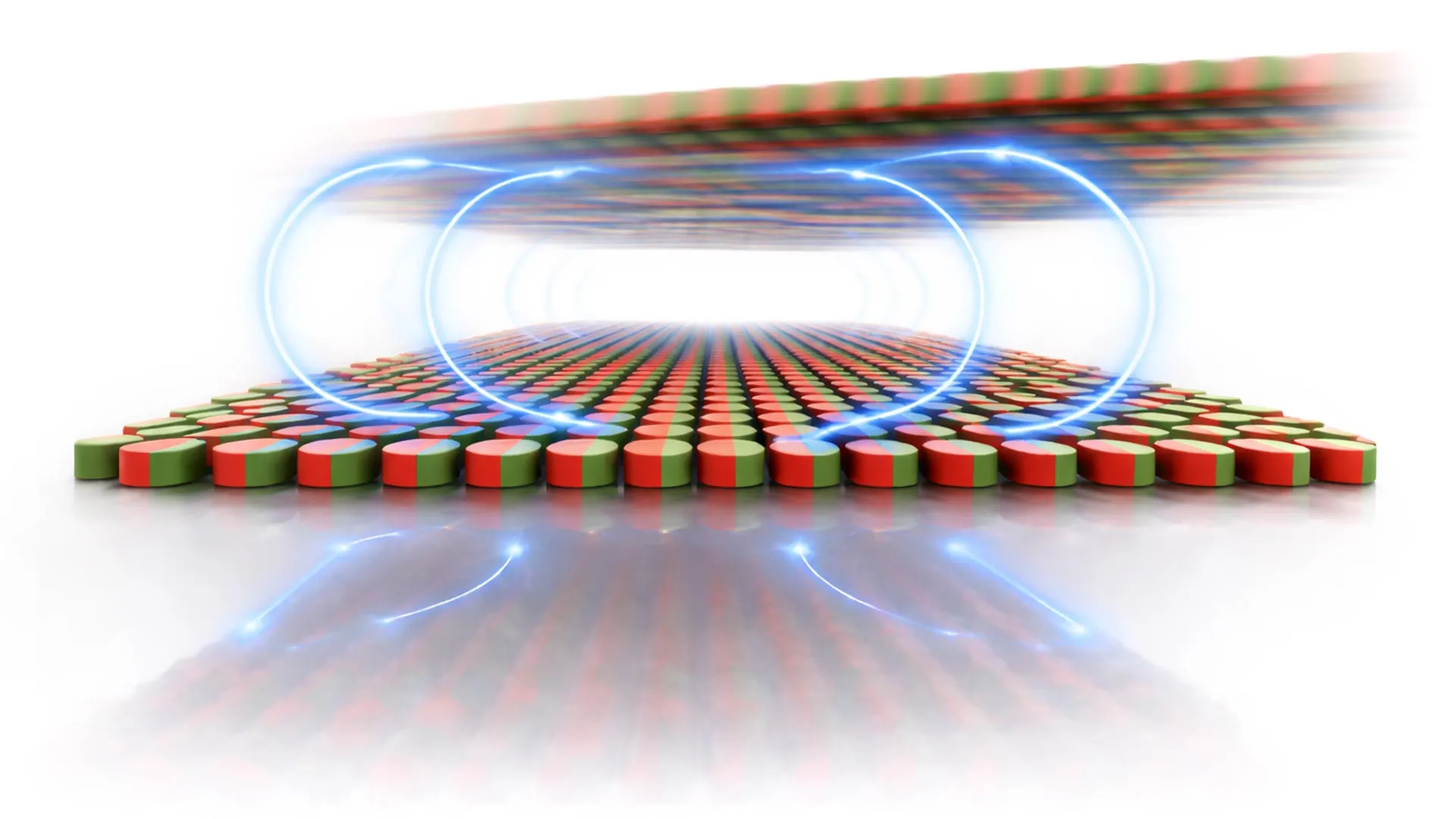
Researchers have uncovered friction without contact—driven entirely by magnetic interactions. As two magnetic layers slide, their internal forces compete, causing constant rearrangements that dramatically increase resistance at certain distances. This creates a surprising peak in friction instead of a steady rise, breaking a long-standing physics law.


Yeah, I think that pushes them apart, keeps them from actually occupying the same space. So that’s definitely involved. But why do molecules moving past each other lose momentum? I could make a guess, but I’m not actually certain. Like I said, physics tends to be pretty unintuitive at this scale.
(Technically I suppose they’re not losing momentum, they’re exchanging it for heat)
I have a private theory that it’s just fields all the way down. E.g., no electrons (as in separate things), just observable points in the one electromagnetic field. This helps me intuit the idea that energy transfers between things — with “transfer” simply being a kind of interaction between separate fields.
Electrons moving past each other slowing down? Can that be reproduced with an electron gun, or would this be based off a larger mass that includes other subatomic particles as well?
Fields aren’t observable. If I sprinkle some magnetic filings around a magnetic field, I will see the filings move, and even conform to the force lines of the field. But, at the end of the day, what I am seeing is the behavior of the particles, not the field. If all that exists are fields, then reality wouldn’t be observable, which clearly contradicts with what we observe.
Of course, you say that there “observable points” added to the field, but I don’t see how this is different form just saying that there are particles in the field, since that’s basically all a particle is, an observable point. Quite literally. Particles are understood as dimensionless points which are defined in terms of their observables.
That’s fair, and I don’t claim that I am not redefining some things in my assessment. It’s more of a philosophical take.
When you “see light,” you’re detecting electromagnetic waves. That’s a physical phenomenon that may or may not count as direct observation, but it’s at least arguable.
Everything could, in theory, be reducible to fundamental parts which are no more “observable” than a field. Those fundamentals could be statistical anomalies, existing as a kind of probability function. The reality you and I have familiarized ourselves with may be the weakly emergent result of endless fields interacting, producing macro behavioral patterns that can be observed as isolated entities like “atoms.”
It’s really not different. I just find the alternative lenses more palatable.
I’m not sure the object’s particles are the observable parts though. When a photon bumps into your table and then into your eye, allowing you to see the table, does it bump directly into the table particles, or does it interact with the particles’ field?
That is string theory fyi
I actually got the idea from Quantum Field Theory. I only called it a “private theory” because I don’t know enough about the theory to actually claim I adhere to it… my understanding is most likely a dumbed down layman version.
Only one way to find out. Fire two election guns at each other and see what happens.
Set one to “stun” and one to “kill”. :)