In Japan, there is tax benefits if your car fits certain dimensions. That’s why there are so many small boxy cars in Japan.
I don’t understand why this isn’t a thing anywhere else. It has so many benefits: Fuel economy, parking space, pedestrian safety, …
But no, “I can see better if I sit higher” is still the #1 killer argument for these urban tanks.
I’m not buying that. Sure, what you say is absolutely true but we’re talking pedestrian deaths. That’s more of the fault of the high steel wall at the front, and that is purely a style choice.
In Finland, car sales tax and yearly tax are based on the Co2 output, and it worked quite well to keep most cars small, light and efficient. Until hybrid and electric cars arrived on the market, that is…
And their relationship with reality. It always reminds me of that graph that shows a modern tank is less likely to hit a child in the road than a GMC Sierra.
Yeah, for sure. There’s an element of failing to grasp basic concepts of physics here, intertwined with a psychology of not wanting to feel small I suppose.
I tried to explain to my sister that you don’t actually see more of the road when you sit higher up, it’s just that the road takes up a larger portion of your field of view. You actually see less of the road because the part directly around your car (the most important part) is obscured. She thought I was twisting words and got angry. If we lived in the USA her 150 cm ass would be driving an F-150.
If the other vehicles around you are blocking your view, she is technically right, and you are technically wrong.
And so many vehicles now have [what I would assume to be factory standard but still illegally] overtinted windows, you can’t even reliably see through the vehicle in front of you
There really does seem to be a kind of social cohesiveness in other countries. In America it’s dog eat dog and fuck everyone else as long as I get mine.
I live in a nice little town here in the US, and I’m a well educated middle aged white guy. It’s safe to say that I get to see a pretty nice version of America even as horrible shit is happening all over the place.
I’ve gotten to spend a few weeks in Sweden of all places over the past few years. Plus I got to see the insides of some airports in other places luke Belgium and Germany.
There’s just something different in the air over there, in a good way. I thought of it as a kind of dignity that came from respect for others as well as oneself, but I like how you call it social cohesiveness.
I think some of the details around food and drink showed it best, and they make good examples because they apply to a mix of the general public.
The food itself is obviously much better over there. Even things like the hotel breakfast or the cafeteria at a workplace had a huge variety of fresh, real foods as opposed to ultraprocessed manufactured branded products.
But the dishes and utensils were some of the most interesting to me as an american. In places like an office cafe at work, or a local restaurant, or I think even an airport, they would have actual GLASSES, plates, and silverware. And on top of that, you would often return your dishes to the kitchen or even put them directly on to the dish washer rack waiting for you.
This breaks my american mind. Fragile non-disposable cups in a public place? Other than coffee mugs on people’s desks or restaurant glasses being dropped off and picked up with at your table, I’m not sure I’ve ever seen that within these borders. If you could use glasses and silverware in public places here, I can’t decide what would happen first: somebody would get cut on one of the immediately broken glasses, or so much of the stuff would get stolen that they’d close it down.
I like to call out their bathrooms too. The way we do it over here is big men’s and women’s restrooms with next to no privacy (it’s one big room with flimsy floating dividers forming the toilet stalls) and stupid culture wars about who should and should not get their genitals inspected or whatever. Over there it’s just several individual doors, each with a small bathroom. Much better privacy, no fodder for the bigots, and much better utilization of the resources.
Not to mention readily available and clean pay toilets. When I was first there I was shocked to learn I had to pay to pee, but now that I’m a gig worker finding a toilet is a pain in the butt
It’s a cost thing, you can get fresh ingredients to make anything and lots of people do. But it comes down to price in terms of dollars and more importantly time. We gotta work 40 hours a week and usually an extra 5 to 10 unpaid commuting in cars we have to pay insurance on (liability in case we have an accident and hurt someone or their property, and if your car is nice liability in case someone hits it and doesn’t have insurance) and fuel.
And when so much of your time and resources are taken this way it’s really easy to take the cheap processed route. Lots of times it’s hard not to
During the time I was most impoverished, I survived (certainly not thrived) on eating mostly moong dal (mung bean kernels and rice ~ combined, they create a complete protien ~ or could use just hempseed/kernels (which would be cheap if we all grew it prolifically like we did a century ago before Bernays, Anslinger and Hearst messed us up)). About 10x cheaper than processed food. Moong dal was not ideal for my constitution and ailments, but 100x to infinitely healthier than replacing food with junk. There be cheap ways to eat healthy food. Just takes a little more thought and strategizing than just taking the cheap plastic wrapped junk. Sympathies for suffering the system that robs us of time and that little cognitive capacity to so strategize better. Every little effort to cease succumbing to it, the better.
Yeah there is a real trend in conservative culture (at least where I grew up) that fits right in with the rest of the anti-intellectualism. And it’s not taught explicitly but it permeates social interactions.
I’m trying to decide how to describe it… Basically, you look down on people who are trying to improve themselves.


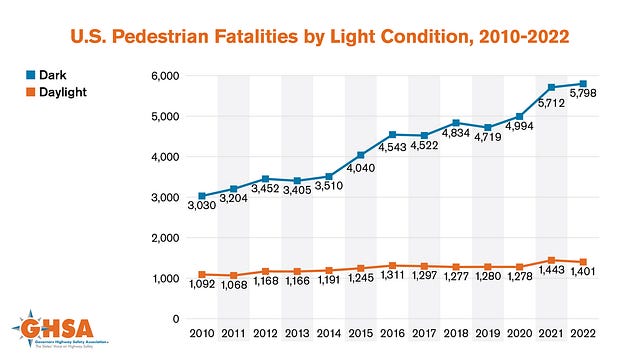
In Japan, there is tax benefits if your car fits certain dimensions. That’s why there are so many small boxy cars in Japan. I don’t understand why this isn’t a thing anywhere else. It has so many benefits: Fuel economy, parking space, pedestrian safety, …
But no, “I can see better if I sit higher” is still the #1 killer argument for these urban tanks.
Japanese import here. :)
One woman nearly broke into tears when she saw how little I had to spend to fill it with fuel.
I think I can see better on my bicycle than in a car, nothing blocking my view and you also sit relatively high compared to cars.
By 2030, they will be stand up driving like speedboats.
A lot of it is because companies want to support the macho American image of guns, trucks, and bacon.
They know these insecure losers will spend more money to look tough in front of their idiot peers.
It’s at least partially the American emission standards, which loosen the emissions requirements as the size of the vehicle grows.
I’m not buying that. Sure, what you say is absolutely true but we’re talking pedestrian deaths. That’s more of the fault of the high steel wall at the front, and that is purely a style choice.
Americans gladly go into more debt to show off the things they can’t afford
In Finland, car sales tax and yearly tax are based on the Co2 output, and it worked quite well to keep most cars small, light and efficient. Until hybrid and electric cars arrived on the market, that is…
Canada had a carbon tax. Pickup sales soared, people will eat dog food before giving up their $200 fill-up trucks.
You mean the “fuel charge” tax on gas, at 17.6 CAD cents (0.11€) per litre?
Because that’s a rather adorable try.
we have a solution for that, actually
“I can see better” says so much about a person’s psychology.
And their relationship with reality. It always reminds me of that graph that shows a modern tank is less likely to hit a child in the road than a GMC Sierra.
Yeah, for sure. There’s an element of failing to grasp basic concepts of physics here, intertwined with a psychology of not wanting to feel small I suppose.
I tried to explain to my sister that you don’t actually see more of the road when you sit higher up, it’s just that the road takes up a larger portion of your field of view. You actually see less of the road because the part directly around your car (the most important part) is obscured. She thought I was twisting words and got angry. If we lived in the USA her 150 cm ass would be driving an F-150.
If the other vehicles around you are blocking your view, she is technically right, and you are technically wrong.
And so many vehicles now have [what I would assume to be factory standard but still illegally] overtinted windows, you can’t even reliably see through the vehicle in front of you
You’re trying to tell me that we need an arms race of taller cars, so we can see past the cars in front of us? For road safety?
Dutch road tax is by weight.
its to stroke the egos of soccer moms, and overcompensating men.
There really does seem to be a kind of social cohesiveness in other countries. In America it’s dog eat dog and fuck everyone else as long as I get mine.
Very much true in my specific limited experience.
I live in a nice little town here in the US, and I’m a well educated middle aged white guy. It’s safe to say that I get to see a pretty nice version of America even as horrible shit is happening all over the place.
I’ve gotten to spend a few weeks in Sweden of all places over the past few years. Plus I got to see the insides of some airports in other places luke Belgium and Germany.
There’s just something different in the air over there, in a good way. I thought of it as a kind of dignity that came from respect for others as well as oneself, but I like how you call it social cohesiveness.
I think some of the details around food and drink showed it best, and they make good examples because they apply to a mix of the general public.
The food itself is obviously much better over there. Even things like the hotel breakfast or the cafeteria at a workplace had a huge variety of fresh, real foods as opposed to ultraprocessed manufactured branded products.
But the dishes and utensils were some of the most interesting to me as an american. In places like an office cafe at work, or a local restaurant, or I think even an airport, they would have actual GLASSES, plates, and silverware. And on top of that, you would often return your dishes to the kitchen or even put them directly on to the dish washer rack waiting for you.
This breaks my american mind. Fragile non-disposable cups in a public place? Other than coffee mugs on people’s desks or restaurant glasses being dropped off and picked up with at your table, I’m not sure I’ve ever seen that within these borders. If you could use glasses and silverware in public places here, I can’t decide what would happen first: somebody would get cut on one of the immediately broken glasses, or so much of the stuff would get stolen that they’d close it down.
I like to call out their bathrooms too. The way we do it over here is big men’s and women’s restrooms with next to no privacy (it’s one big room with flimsy floating dividers forming the toilet stalls) and stupid culture wars about who should and should not get their genitals inspected or whatever. Over there it’s just several individual doors, each with a small bathroom. Much better privacy, no fodder for the bigots, and much better utilization of the resources.
Not to mention readily available and clean pay toilets. When I was first there I was shocked to learn I had to pay to pee, but now that I’m a gig worker finding a toilet is a pain in the butt
I feel like if I were in USA, confronted by that wall of
and I asked for real food; ingredients to cook a meal from,
it’d be like asking for water in Idiocracy.
https://www.youtube.com/watch?v=-YZnORoAWkA
It’s a cost thing, you can get fresh ingredients to make anything and lots of people do. But it comes down to price in terms of dollars and more importantly time. We gotta work 40 hours a week and usually an extra 5 to 10 unpaid commuting in cars we have to pay insurance on (liability in case we have an accident and hurt someone or their property, and if your car is nice liability in case someone hits it and doesn’t have insurance) and fuel.
And when so much of your time and resources are taken this way it’s really easy to take the cheap processed route. Lots of times it’s hard not to
During the time I was most impoverished, I survived (certainly not thrived) on eating mostly moong dal (mung bean kernels and rice ~ combined, they create a complete protien ~ or could use just hempseed/kernels (which would be cheap if we all grew it prolifically like we did a century ago before Bernays, Anslinger and Hearst messed us up)). About 10x cheaper than processed food. Moong dal was not ideal for my constitution and ailments, but 100x to infinitely healthier than replacing food with junk. There be cheap ways to eat healthy food. Just takes a little more thought and strategizing than just taking the cheap plastic wrapped junk. Sympathies for suffering the system that robs us of time and that little cognitive capacity to so strategize better. Every little effort to cease succumbing to it, the better.
Yeah there is a real trend in conservative culture (at least where I grew up) that fits right in with the rest of the anti-intellectualism. And it’s not taught explicitly but it permeates social interactions.
I’m trying to decide how to describe it… Basically, you look down on people who are trying to improve themselves.
My freedoms>your kids life
-Americans