

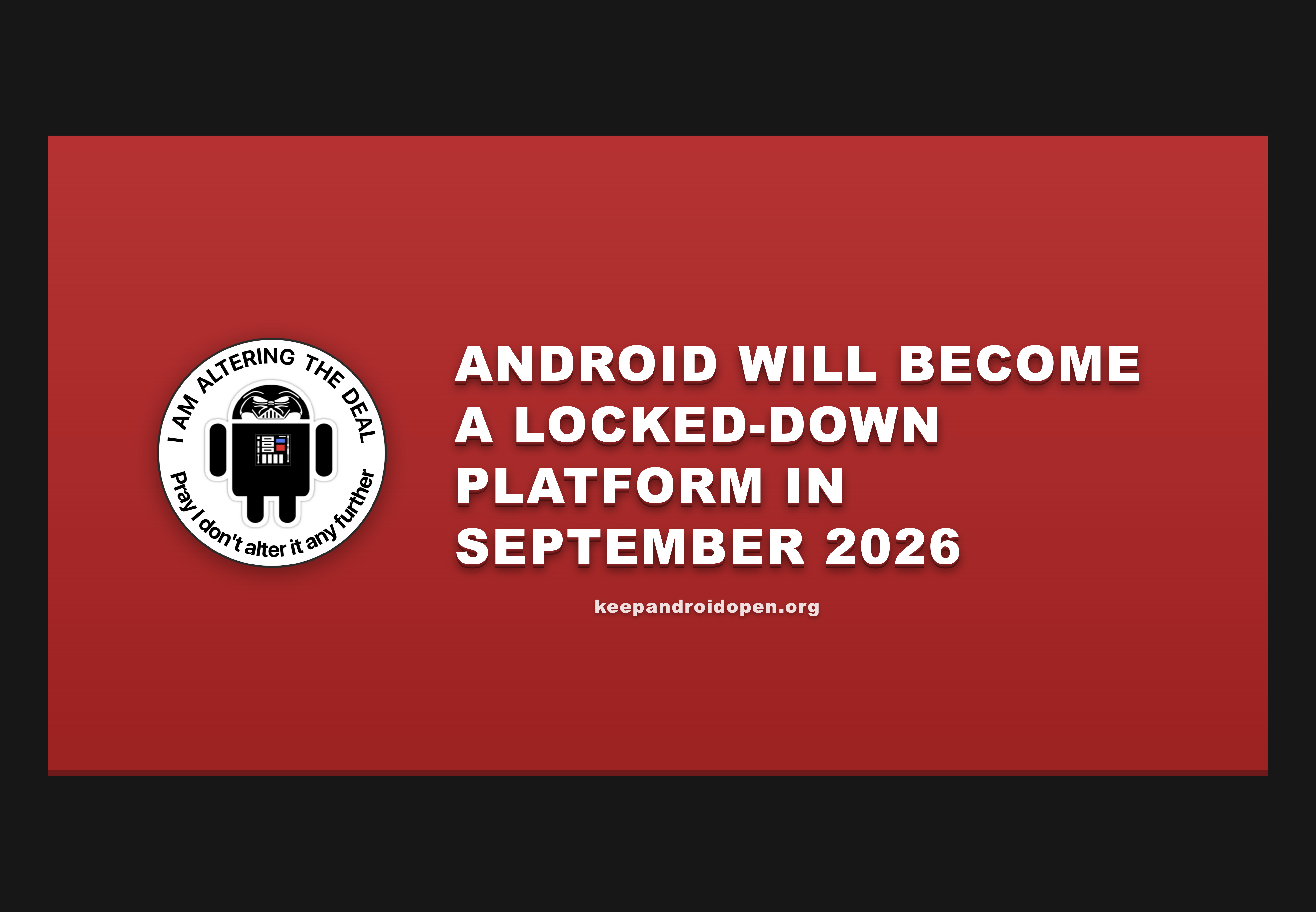
If you haven’t seen this yet, Google is planning to require mandatory developer identity verification for all Android apps, including apps distributed outside the Play Store, taking effect September 2026. This affects every independent and open source Android developer directly.
This is not just about the Play Store. After September 2026, on any certified Android device, applications from unverified developers will be blocked by default. The only proposed bypass, the “advanced flow”, exists only as a blog post and has not appeared in any beta, dev preview, or canary release. No one outside Google has seen it.
The community has been fighting back at keepandroidopen.org:
- Read the full breakdown of what this means
- Sign the open letter (organisations only)
- Contact your national regulators — contacts listed by country on the site
- Add the countdown banner to your project
September 2026 is closer than it looks. The time to push back is now.
Wait that’s not a thing already?
So people can just make scam apps and once you report it to the App Store there is no recourse because even the company doesn’t know who they are?
So the way compute used to work, is you could install any program you want from anywhere. You could buy a program from a web site or copy a disk and install the program.
Smartphones have been around since the late 1990s in various forms, it used to be, you could just install whatever you want.
Then, in 2008, Apple released the iPhone app store, and it was a closed space, a “walled garden”. You can only install apps on their phone if they approve them.
Google decided to join the phone race and released a phone where one could still install applications from anywhere, not just their store. There are multiple stores like others have mentioned, or you can download an APK file from anywhere and install it on your phone.
Part of their behavior since is slightly open to interpretation, as the technology is now used by everyone, not just tech nerds. People could install “bad” programs, and they could lose money, cell networks could be compromised, etc.
It likely costs a lot of companies a lot of money to deal with dumb users doing stupid shit. So from one perspective, making it extremely hard to install unknown programs from anywhere will curb that expense.
It could be a defensive move, as LLMs now allow anyone to write computer software with very little knowledge of it, and it is just bad timing.
On the other hand, since the beginning of computers, the owner of the machine could run whatever software they wanted.
This move by Google is basically making it so there is NO mobile compute platform that the owner of the device actually owns, and is allowed to do with their hardware what they want. Apple or Google, that is it. Apple had always been closed, which should have been made illegal, but I digress.
It has been a slippery slope with Android for almost 2 decades, and this move is basically the end of the ability for free humans to install free software from anywhere on the hardware they own and paid anywhere up to $3000 for.
Basically a huge dive for personal freedom on a planetary scale, decided by one corporation.
The recourse has been removal.
And the solution proposed is not requiring identification specifically for Play store developers, but any developer at all.
Removal but no means for consumers to seek money back or damages because it’s just the Wild West?
I think if you’re publishing an app to a public store then they should know who the fuck you are.
This includes not in the Google play store so like f-droid or like how people would get software from a places website or GitHub or sourceforge or wherever and installing it like you can on Windows or a Mac or Linux